HEALTHCARE · 2025-2026
Healthcare AI | Case Study
Voice-driven intake and documentation that gives clinicians their evenings back.
00 · CONTEXT
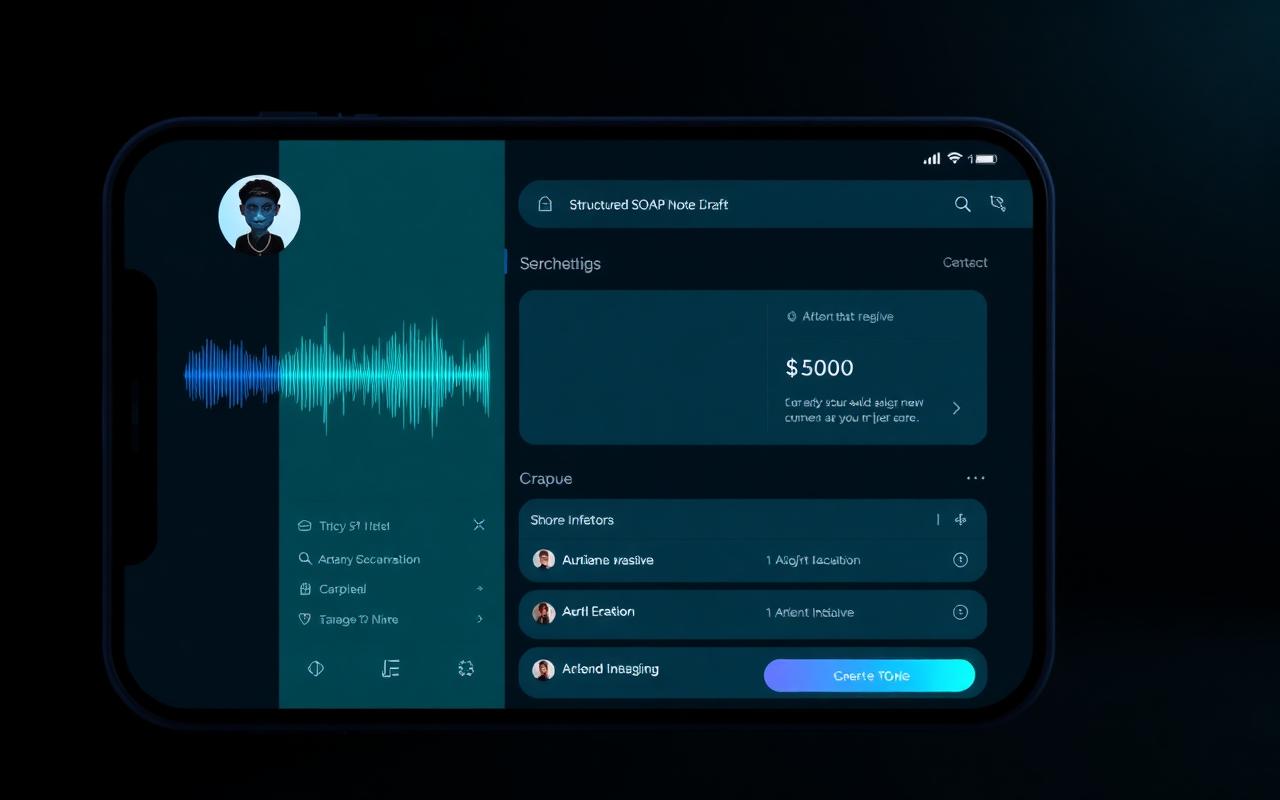
Voice-driven intake and clinical documentation deployed across 38 clinics, producing around 9,000 notes a day and giving clinicians back roughly two hours of evening admin.
01 · PROBLEM
Clinicians spent two hours a day on documentation, and intake queues bottlenecked at the front desk.
02 · STRATEGY
Capture at the point of care. Ambient voice becomes structured records with clinician sign-off as the only manual step.
03 · DESIGN
Glanceable review screens designed for 15-second interactions between patients.
04 · ENGINEERING
Streaming speech-to-text, structured extraction with clinical vocabularies, and strict PHI isolation.
05 · CHALLENGES
Documentation eats clinical time
Two hours a day per clinician, mostly after the last patient left.
Clinical language is unforgiving
Medication names, dosages and negations must be transcribed exactly or the note is dangerous, not just wrong.
PHI handling
Every byte of patient data needed isolation, retention rules and a defensible audit position.
06 · PROCESS
Ambient recording during the consultation, so nothing is reconstructed from memory afterwards.
Transcripts map into structured fields using clinical vocabularies, with negation and dosage handling tuned against clinician-reviewed samples.
Review screens designed for the gap between patients: glanceable, diff-highlighted, sign-off in one action.
Per-tenant encryption, strict retention windows and no training on patient data, verified before each clinic rollout.
07 · THE SOLUTION
- Ambient voice capture with speaker separation
- Structured note drafting with clinical vocabularies
- Intake triage queue for front-desk staff
- Clinician review and sign-off workflow
- Template library per specialty
- Encrypted, auditable PHI storage
08 · ARCHITECTURE
- Streaming speech-to-text pipeline
- Python extraction services with clinical terminology mapping
- Encrypted PostgreSQL with per-tenant isolation
- Next.js clinician console optimised for short interactions
09 · RESULTS
- 64% reduction in documentation time
- Front-desk intake queue cut in half
- Deployed across 38 clinics
10 · WHAT IT TAUGHT US
Clinicians adopted it the moment review took under fifteen seconds. Accuracy mattered, but the sign-off interaction decided the rollout.
11 · STACK
RELATED CASE STUDIES
RELATED READING
RAG systems that survive production
Most retrieval systems die in the gap between a convincing demo and a Monday morning with real questions. Here is the architecture that holds.
Agents need permissions, not personalities
The interesting part of an autonomous agent is not what it can do. It is the exact list of things it is allowed to do, and what happens when it tries something else.
Automate the boring middle
The biggest wins are rarely at the start or end of a process. They are in the copy-paste swamp in the middle.